

Types
Position
Layout
blog
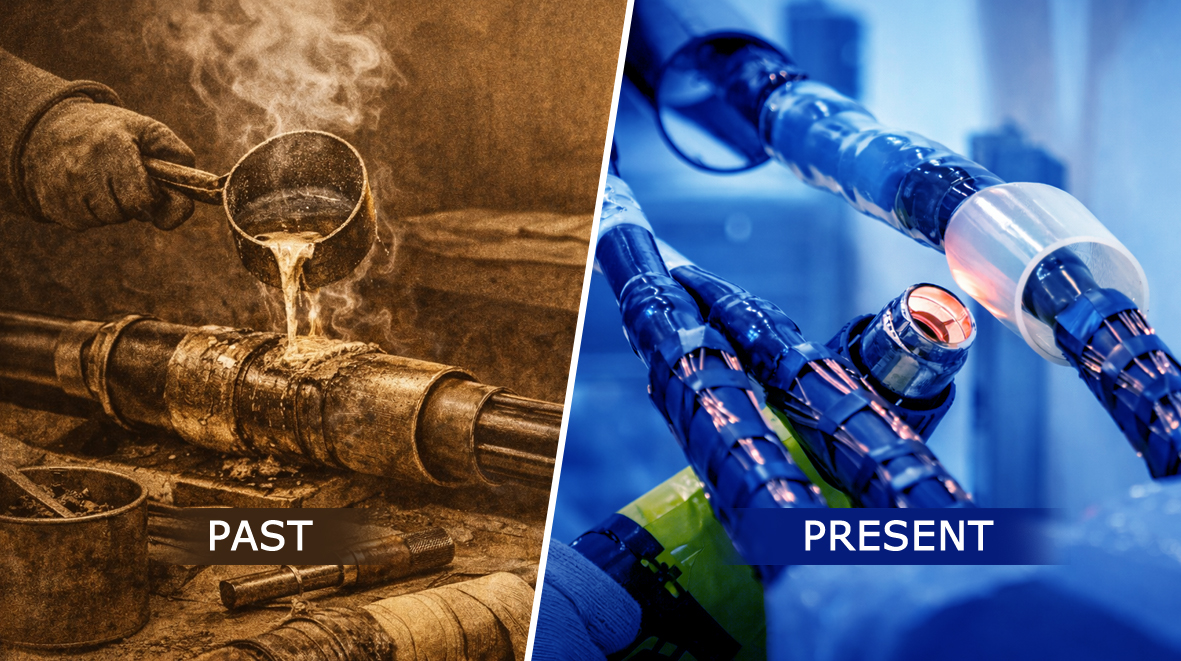
When underground power cables fail, the problem often lies in the joints connecting them. At Compaq International, with over 27 years of manufacturing excellence, we've witnessed how cable joint technology has transformed from unreliable lead assemblies to today's advanced polymer systems that power India's grid and 40+ countries worldwide.
The Birth of Cable Joints
Early cable joints from the 1880s were crude assemblies- mechanically spliced conductors wrapped in rubberized tape and encased in hand-poured lead sleeves. These primitive joints failed frequently, often within just a few years due to moisture ingress, oxidation, and cracking.
The Art of Lead Wiping
By the 1900s, oil-impregnated paper insulation became standard, requiring absolutely moisture-tight enclosures. Cable jointers would hand-tape layers of paper over spliced conductors, then create watertight seals using molten lead at 350°C- a craft requiring years to master.
Each joint took 4-6 hours to complete, and quality varied dramatically based on the jointer's skill. Bitumen compounds filled the lead sleeves to insulate and seal the paper layers, but these materials softened at high temperatures and remained vulnerable to moisture.
The Challenge: Managing electrical stress at insulation cutoffs. In the 1920s-1930s, engineers discovered that stress relief cones- carefully tapered paper layers- reduced field concentrations that caused failures at medium voltages.
Reliability Reality: Lead-sleeve joints suffered 5-15 failures per 100 joint-years, meaning a 50% probability of failure within 7-20 years—unacceptable by modern standards.
Pre-Moulded Components Change Everything
Post-World War II synthetic rubber technology revolutionized cable jointing. Instead of hand-taping in the field, manufacturers began producing factory-made components with built-in stress control geometry.
Key Advantages:
Heat-Shrink Technology Arrives
The late 1950s brought heat-shrink technology. These materials could be expanded at the factory, then shrunk onto cables in the field using heat creating intimate contact that eliminated voids and interface problems.
Heat-shrink offered game-changing benefits: simple installation, versatility across cable sizes (3:1 or 4:1 recovery ratios), and significantly reduced human error. This technology became the foundation for modern medium-voltage joints- the same principle Compaq International uses in our heat shrink cable joints serving utilities, renewable companies, industries across India and globe.
XLPE Cables Create New Challenges
The introduction of cross-linked polyethylene (XLPE) insulation in the 1960s offered superior electrical and thermal properties plus inherent moisture resistance. However, XLPE's thermosetting nature required new jointing approaches using EPR rubber components with specialized stress control.
Reliability Improvement: Early polymer joints achieved 2-8 failures per 100 joint per years- a major improvement, though still problematic compared to modern systems.
Computer-Aided Design Revolutionizes Stress Control
Finite element analysis (FEA) software in the 1980s-1990s allowed engineers to precisely model electric field distribution. Modern joints combine three stress control techniques:
At Compaq International, our engineering team uses FEA modeling to achieve field enhancement factors below 1.5 verified through type testing at KEMA, CPRI, and ERDA laboratories according to IEC 60502-4, HD 629.1 and IS 13573-2 standards.
Cold-Shrink Technology: The Latest Innovation
Cold-shrink joints, developed in the 1980s-1990s, represent perhaps the most significant recent advancement. These use pre-expanded silicone or EPR rubber held on removable plastic cores. Installation is simple: position the component, remove the core, and elastic memory shrinks it tightly onto the cable- no heat required.
Cold-Shrink Advantages:
Compaq International's cold shrink cable joints and terminations have proven invaluable across India- from Himalayan cold to Rajasthan's desert heat, monsoon flooding in Kerala to industrial pollution in urban centers.
Separable Connectors Enable Grid Flexibility
Unlike permanent joints, separable connectors allow cables to be disconnected and reconnected without destroying the termination. This flexibility enables equipment replacement, network testing, and faster fault repair critical for modern utility operations and industrial facilities.
Our separable connectors incorporate sophisticated stress control at interfaces, meeting stringent international standards while providing the operational flexibility Indian utilities increasingly demand.
Smart Monitoring: The Digital Future
The latest evolution integrates sensors directly into joints monitoring temperature, partial discharge, and moisture in real-time. This condition-based approach shifts maintenance from fixed schedules to predictive analytics, potentially saving millions while improving reliability.
Current Reliability: Modern polymer systems achieve below 0.1 failures per 100 joint-years—50 to 100 times more reliable than 1950s technology.
From Import Dependency to Indigenous Excellence
Founded in 1998, Compaq International became India's first local manufacturer of medium-voltage power cable accessories. Our ISO 9001:2015 and ISO 14001:2015 certified facility produces a comprehensive range:
Global Recognition
Type-tested by KEMA (Netherlands), CPRI, and ERDA, our products serve power distribution networks in 40+ countries across Asia, Africa, and the Middle East- proving that Indian manufacturing can meet the highest international quality standards.
The Future: Innovation Continues
As India pursues ambitious renewable energy targets and grid modernization, cable joint technology continues evolving:
Compaq International actively participates in industry standards development, ensuring our products remain at the forefront of these technological advances.
From lead sleeves taking 6 hours to install with 5-15% failure rates, to modern polymer systems installed in 15 minutes with 0.1% failure rates- cable joint evolution demonstrates how sustained engineering innovation transforms infrastructure reliability.
As India's pioneering local manufacturer, Compaq International continues this legacy of innovation, delivering world-class cable accessories that meet international standards while addressing India's unique requirements.
Contact Compaq International for technical specifications, product catalogs, or engineering support for your power distribution projects.

Need Help?
Our experts are ready
Our experts are available for on-site support, remote
guidance and tailored engineering.