

Types
Position
Layout
blog
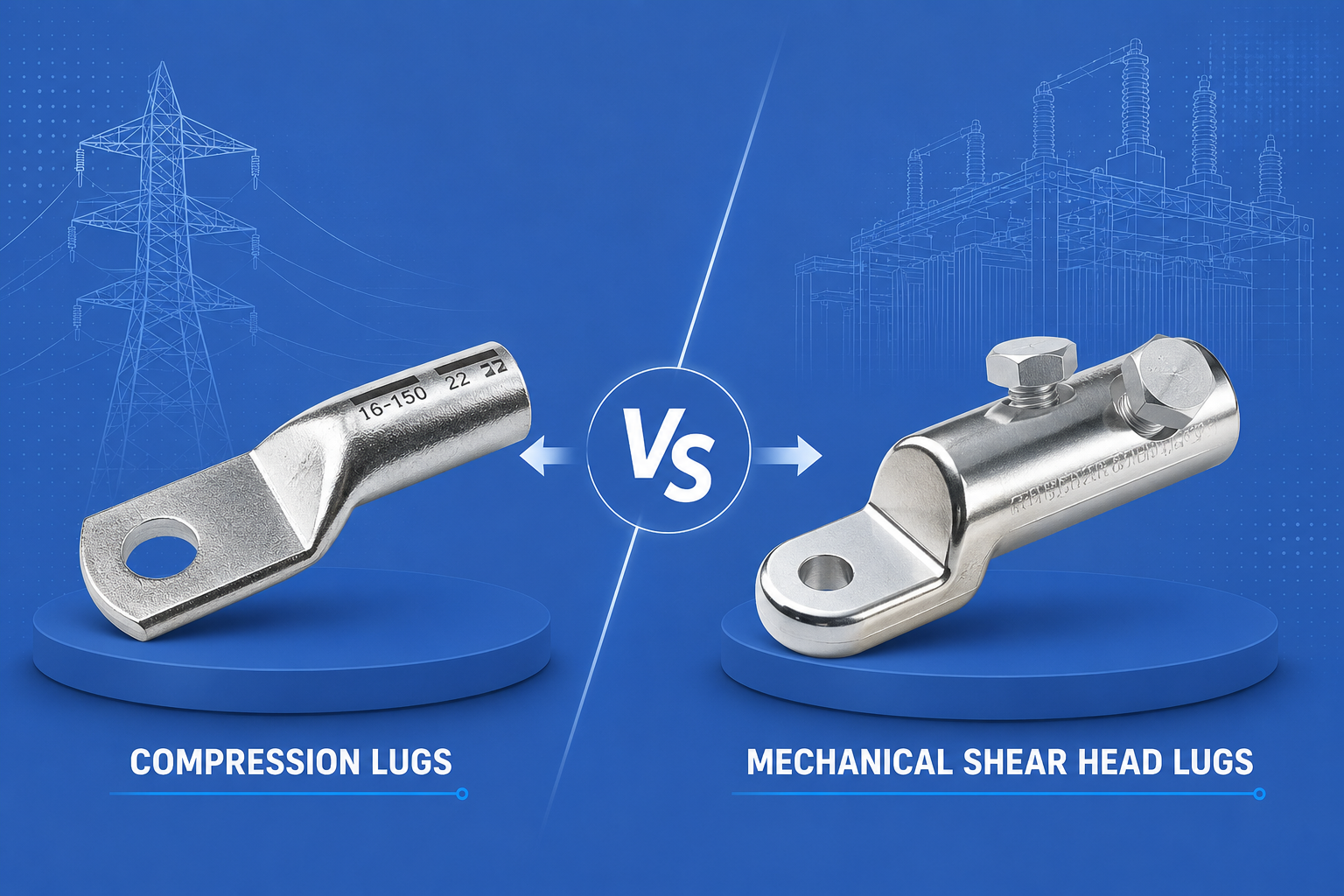
When engineers discuss cable accessories, the conversation usually focuses on joints, terminations or connectors.
But one component often decides whether the entire installation performs reliably for years—a cable lug.
A cable lug is a simple product, but choosing the wrong one can lead to overheating, loose connections, difficult installations and unnecessary maintenance.
One question we hear regularly is:
There isn't a single answer because both technologies have their place. The right choice depends on your project, installation conditions, available tools and maintenance requirements.
In this guide, we'll explain the differences in simple terms, where each type performs best and what engineers should consider before making a decision.
A cable lug forms the electrical and mechanical connection between the conductor and the equipment terminal.
That connection must:
Even if you use the best cable joint or termination kit, a poor cable connection can reduce the overall reliability of the installation.
That's why connector selection deserves as much attention as the cable accessory itself.
A compression lug is a connector that is permanently attached to the conductor using a hydraulic crimping tool and matching dies.
During crimping, the barrel of the lug is compressed around the conductor, creating a strong mechanical grip and a low-resistance electrical connection.
Compression technology has been used for decades and remains widely accepted across utilities, industries and infrastructure projects.
Typical Applications
A mechanical lug uses specially designed shear head bolts instead of hydraulic crimping.
The installer inserts the conductor into the barrel and tightens the bolts.
Once the correct installation torque is reached, the bolt heads automatically shear off, leaving the remaining bolts at the intended tightening force.
This removes much of the guesswork from installation and eliminates the need for hydraulic crimping equipment.
|
Feature |
Compression Lug |
Mechanical Shear Head Lug |
|
Installation |
Hydraulic crimping |
Tighten shear bolts |
|
Special tools |
Hydraulic crimper and dies |
Standard socket or torque wrench |
|
Installation speed |
Moderate |
Fast |
|
Portability |
Heavy tooling required |
Minimal tooling |
|
Installation consistency |
Depends on correct crimping |
Controlled by shear bolts |
|
Multiple conductor sizes |
Usually one size |
Many designs cover a conductor range |
|
Emergency repairs |
Less convenient |
Very suitable |
|
Remote sites |
Tool logistics required |
Easier to install |
|
Operator skill |
Higher |
Lower |
|
Maintenance |
Minimal |
Minimal |
Neither product is better in every situation.
The best choice depends on where and how it will be installed.
Compression lugs remain the preferred option in many planned installations where hydraulic crimping equipment is readily available.
They are commonly selected because they offer:
When experienced installers have the correct crimping equipment, compression lugs continue to be an excellent choice.
Mechanical lugs have become increasingly popular because they simplify installation.
Instead of carrying heavy crimping equipment and multiple die sets, installers only need basic tightening tools.
This makes them especially useful for:
For contractors working across different cable sizes, mechanical lugs can also reduce the number of connector variants that need to be carried on site.
The biggest difference between these two technologies is installation.
Compression Lug Installation
A reliable crimp depends on several factors:
If any of these are incorrect, the quality of the connection can be affected.
Mechanical Lug Installation
Installation is generally simpler.
The process typically involves:
Because the bolts are designed to shear at the intended torque, installation consistency is easier to achieve.
When both products are:
both provide excellent electrical performance for their intended applications.
The more important factor is not whether the connector is compression or mechanical.
It is whether the connector has been correctly selected, installed and tested.
A high-quality connector installed correctly will almost always outperform a premium connector installed incorrectly.
Many connection failures are not caused by the product itself.
They result from installation errors.
Some common mistakes include:
Proper training and following the installation guide remain just as important as product selection.
Mechanical shear head lugs are increasingly being used in:
Their ease of installation and reduced tooling requirements make them particularly attractive where speed and flexibility matter.
Which Industries Still Prefer Compression Lugs?
Compression lugs continue to be widely specified in:
Many utilities continue to use compression technology because of decades of field experience and established installation procedures.
Before making your decision, ask these questions:
Answering these questions usually makes the right choice much clearer.
Can a mechanical lug replace a compression lug?
In many applications, yes—provided it meets the project specification, conductor type, voltage level and applicable standards. Always verify the installation requirements and manufacturer's recommendations.
Are mechanical lugs suitable for medium-voltage cable accessories?
Yes. Mechanical lugs tested to relevant standards are commonly used in medium-voltage cable accessories, depending on the system design and project requirements.
Which installation is faster?
Mechanical shear head lugs are generally faster because they do not require hydraulic crimping equipment or multiple die sets.
Are compression lugs more reliable?
Both technologies are reliable when correctly selected, installed and tested. Installation quality is often more important than the connector type itself.
Final Thoughts
The discussion shouldn't be about whether compression lugs or mechanical shear head lugs are universally better.
It should be about selecting the right connector for the job.
Compression lugs remain a trusted solution for many planned installations where crimping equipment is available and established procedures are in place.
Mechanical shear head lugs offer faster installation, reduced tooling and greater flexibility, making them increasingly popular for renewable energy, infrastructure upgrades, maintenance work and projects where efficiency on site matters.
The best connection is not simply the one that costs less or installs faster. It is the one that delivers consistent electrical performance, mechanical strength and long-term reliability throughout the life of the cable system.
At COMPAQ International, we understand that every project has different installation challenges. That's why we offer both compression lugs and mechanical shear head lugs, engineered for dependable electrical performance and ease of installation across low- and medium-voltage applications.
Whether you're working on a utility network, renewable energy project, industrial facility or infrastructure upgrade, our technical team can help you select the right connector for your application.
Need help choosing the right lug? Contact COMPAQ's technical experts for product selection, application guidance and project support.

Need Help?
Our experts are ready
Our experts are available for on-site support, remote
guidance and tailored engineering.