

Types
Position
Layout
blog
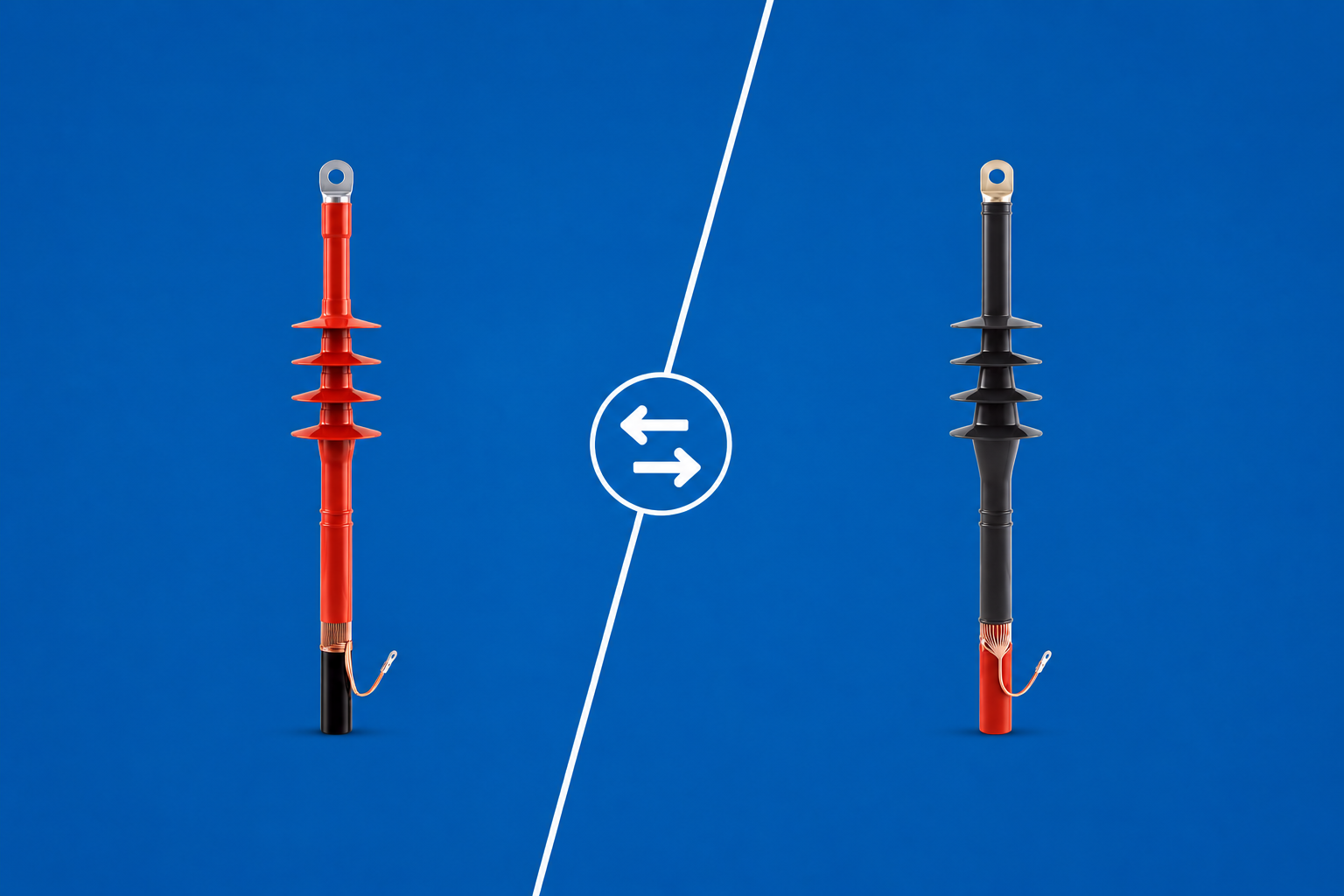
If you've worked with medium-voltage cable systems, you've probably heard this question many times.
"Which is better? Heat Shrink or Cold Shrink?"
It's a fair question.
But it's also the wrong one.
The better question is:
Both Heat Shrink and Cold Shrink have been successfully used around the world for decades. Both are capable of delivering reliable cable joints and terminations when the right product is selected and installed correctly.
The biggest mistake isn't choosing Heat Shrink.
The biggest mistake isn't choosing Cold Shrink.
The biggest mistake is choosing the wrong technology for the application.
Let's understand why.
Every cable has to be connected somewhere.
It may connect to another cable.
It may terminate inside a switchgear.
It may connect to a transformer.
Whenever a cable is cut, its original factory insulation is interrupted.
A cable accessory rebuilds that insulation system while also providing:
Without a properly designed accessory, even the best cable can fail prematurely.
Heat Shrink accessories are manufactured from specially formulated cross-linked polymer materials.
During manufacturing, the material is expanded.
At site, controlled heating allows it to shrink back tightly around the cable.
As it shrinks, it creates:
This technology has been used successfully across utility networks, industries, renewable energy projects and infrastructure for many decades.
Cold Shrink works differently.
Instead of applying heat, the accessory is supplied pre-expanded over a removable spiral core.
Once positioned on the cable, the installer simply removes the core.
The elastic material contracts naturally around the cable.
No torch.
No heat gun.
No flame.
The sealing pressure comes from the material's elastic recovery rather than thermal shrinkage.
Many people think the only difference is whether heat is used.
Actually, that's only one part of the story.
The real differences include:
|
Feature |
Heat Shrink |
Cold Shrink |
|
Installation |
Requires controlled heating |
No heat required |
|
Mechanical Protection |
Excellent |
Good |
|
Installation Speed |
Moderate |
Faster |
|
Special Equipment |
Heat source required |
No heating equipment |
|
Hazardous Areas |
May not always be suitable |
Preferred where open flame is restricted |
|
Cost |
Generally more economical |
Usually higher initial cost |
|
Installer Skill |
Proper heating technique is important |
Simpler installation process |
Neither technology is automatically superior.
Each has its place.
Heat Shrink continues to be the preferred choice for many utilities, EPC contractors and industrial projects.
It is particularly suitable when:
This is one reason Heat Shrink remains widely used across power distribution networks worldwide.
Cold Shrink offers clear advantages in certain situations.
It is often selected when:
Many renewable energy projects, process industries and confined installation areas benefit from these advantages.
Common Misconceptions
"Cold Shrink always lasts longer."
Not necessarily.
Service life depends on many factors including:
No technology can compensate for poor installation.
"Heat Shrink is outdated."
Not at all.
Modern Heat Shrink systems continue to evolve with improved materials, stress-control designs and environmental sealing.
They remain a preferred solution for thousands of utility projects every year.
"Cold Shrink is easier, so it's always better."
Simpler installation does reduce some installation risks.
However, product selection should always consider:
One point often gets overlooked.
Most cable accessory failures don't happen because the technology was wrong.
They happen because of:
Even the highest-quality accessory cannot compensate for poor workmanship.
Proper training, correct installation procedures and following the manufacturer's instructions remain critical to long-term performance.
Whether selecting Heat Shrink or Cold Shrink, always look for products designed and tested to recognized international standards applicable to the voltage class and application, such as IEC 60502-4 or IS 13573-2 or HD 629.1-S3 and other relevant utility specifications where required. Products should also be supported by type-test documentation from recognized laboratories where applicable.
At COMPAQ International, we don't believe one technology fits every application.
Instead, we evaluate:
Only then do we recommend the most suitable solution.
That's how cable accessories should be selected.
Final Thoughts
So...
Heat Shrink or Cold Shrink?
The answer isn't about choosing the latest technology.
It's about choosing the right technology.
When the product is properly designed, manufactured to international standards, correctly selected and professionally installed, both technologies can provide reliable long-term performance.
The best solution is the one that matches your application—not the one that's simply more popular.
Is Heat Shrink better than Cold Shrink?
Neither is universally better. The right choice depends on the application, installation conditions, safety requirements and project specifications.
Can Heat Shrink be used outdoors?
Yes. Properly designed Heat Shrink accessories are widely used in outdoor utility and industrial installations.
Is Cold Shrink faster to install?
Generally, yes. Since no heating equipment is required, installation can often be completed more quickly.
Which technology costs less?
Heat Shrink products often have a lower initial material cost, while Cold Shrink may reduce installation time in some applications. Total project cost should consider both material and labor.
Can both technologies be used on medium-voltage cables?
Yes. Both Heat Shrink and Cold Shrink technologies are widely available for medium-voltage cable joints and terminations, provided the selected product matches the cable type, voltage class and applicable standards.

Need Help?
Our experts are ready
Our experts are available for on-site support, remote
guidance and tailored engineering.