

Types
Position
Layout
blog
Power cable accessories are expected to operate reliably for decades, often under continuous electrical loading, thermal cycling, environmental exposure, and varying network conditions. While considerable attention is typically given to cable selection and installation practices, the long-term reliability of a cable system is often determined by the performance of its joints and terminations.
One of the most important factors influencing the service life of a cable accessory is the management of electrical stress.
Stress Control Technology is therefore not simply a product feature—it is a fundamental engineering requirement that helps prevent insulation degradation, improve electrical performance, and ensure long-term network reliability.
In an insulated power cable, the electric field is distributed in a controlled manner between the conductor and the metallic screen. Along the length of the cable, this distribution remains relatively uniform.
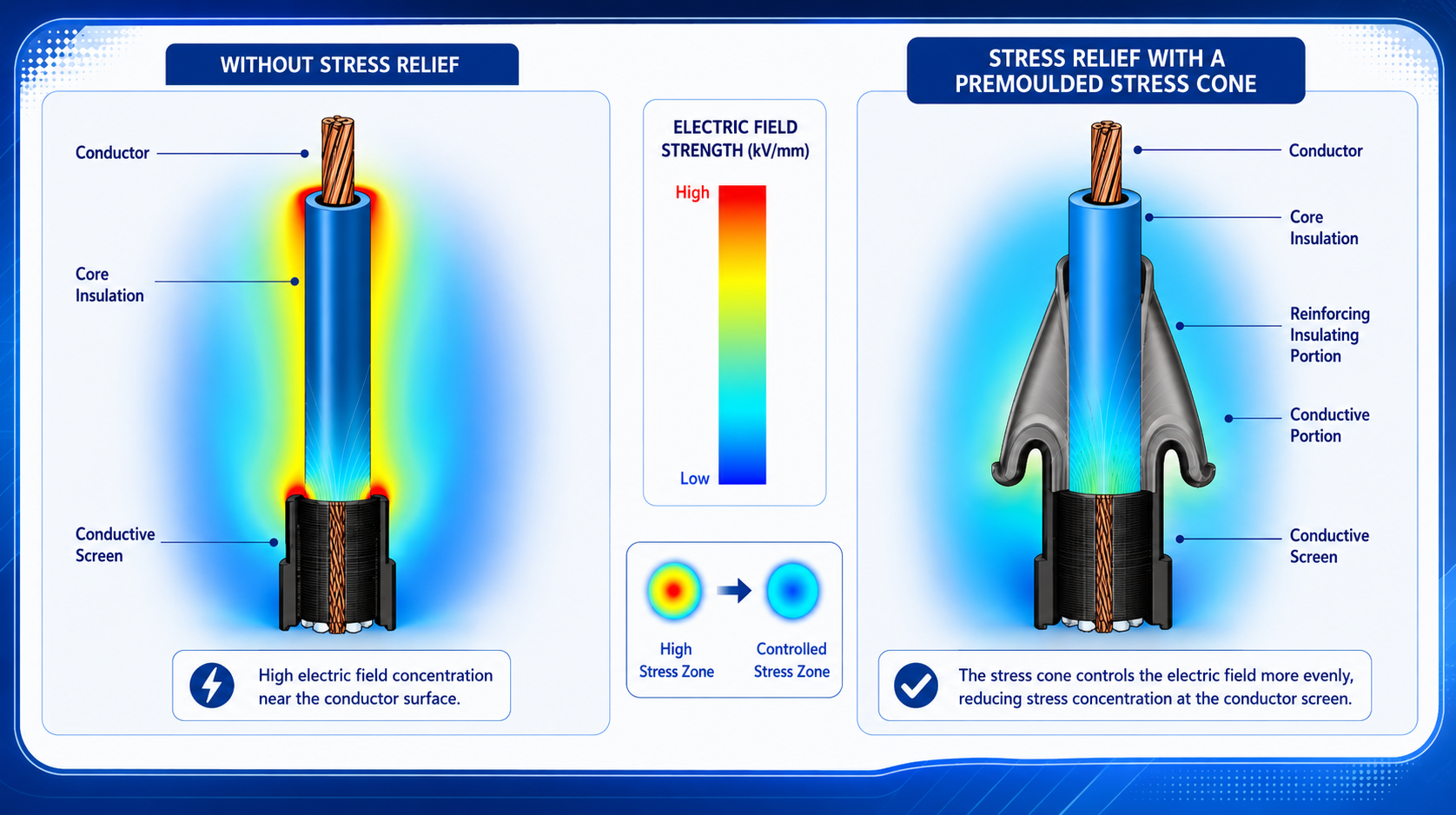
However, during the installation of a cable termination, the outer conductive screen must be removed to expose the insulation and conductor. This creates a transition point known as the screen cut-back region.
At this location, the electric field can no longer follow its original path and becomes concentrated near the end of the conductive screen. As a result, the electrical stress at this interface increases significantly compared to other parts of the cable system.
If this stress concentration is not properly controlled, it can become the starting point for long-term insulation deterioration. 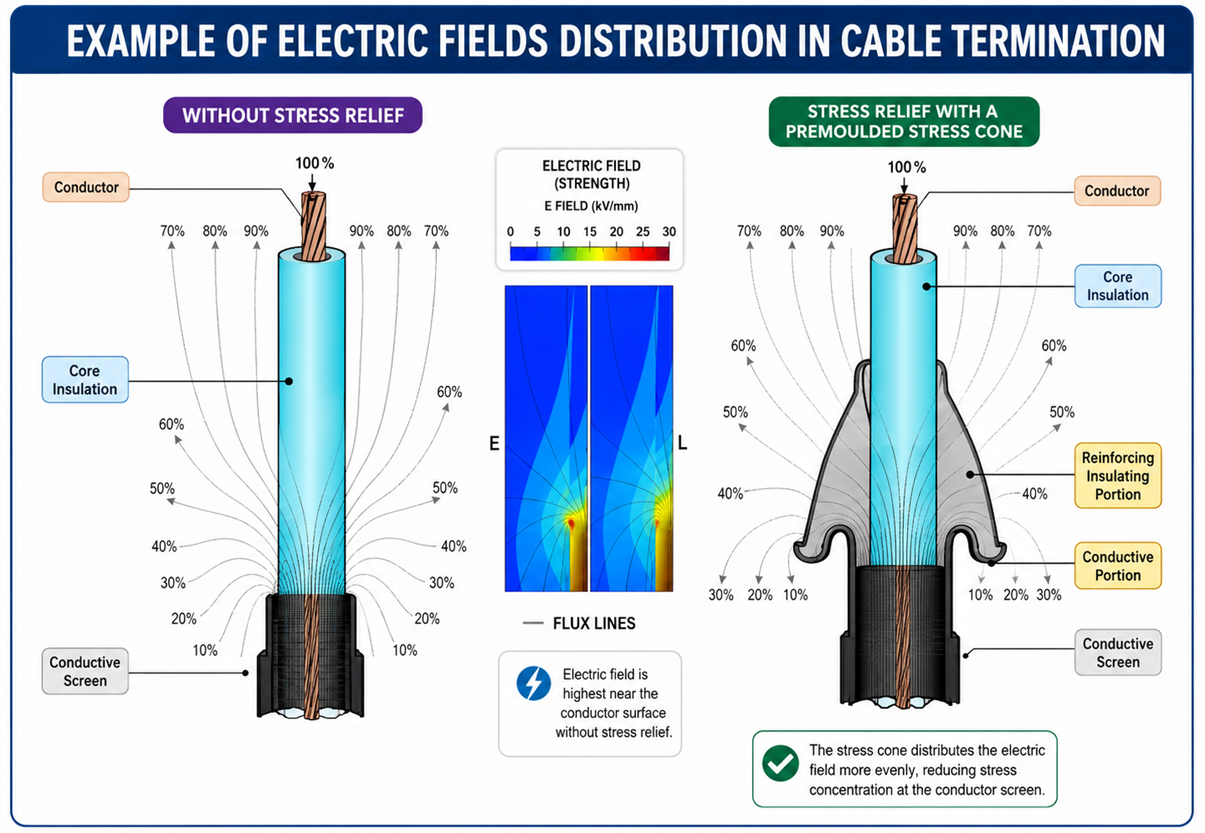
Figure 1 demonstrates the difference between a cable termination without stress control and one incorporating a premoulded stress cone.
On the left side, the electric field lines become densely concentrated around the screen cut-back area. This indicates a localized increase in electric field intensity, creating a highly stressed region within the insulation system.
On the right side, the pre-moulded stress cone redistributes the electric field over a larger area. Instead of concentrating at one point, the electrical stress is graded gradually along the insulation interface.
The result is a more uniform electric field distribution and a significant reduction in peak stress levels.
The purpose of stress control is therefore not to reduce voltage, but to manage how the electric field behaves within the accessory.
Electrical stress rarely causes immediate failure. More commonly, it initiates a gradual ageing process that develops over many years of operation.
Excessive electric field intensity can contribute to several well-known insulation degradation mechanisms.
Localized electrical stress may initiate partial discharge within microscopic voids, contamination, or imperfections present in the insulation system.
Although individual discharges are small, repeated activity can progressively erode insulation materials and weaken electrical performance over time.
Sustained electrical stress can lead to the formation of microscopic branching channels within the insulation. These structures, known as electrical trees, gradually propagate through the material and can ultimately result in insulation breakdown.
In humid, contaminated, or coastal environments, elevated electrical stress may encourage the formation of conductive paths along insulation surfaces. This phenomenon, known as tracking, can eventually lead to flashover and service failure.
These mechanisms are among the most common causes of premature cable accessory failures worldwide.
Stress control systems are specifically designed to regulate the electric field at critical interfaces.
By controlling the shape and distribution of the electric field, stress grading components reduce localized stress concentrations and prevent excessive electrical loading of the insulation.
Modern cable accessories typically use one or more of the following approaches:
Geometric stress control utilizes specially engineered stress cones and field-grading profiles to redistribute the electric field through component geometry. The premoulded stress cone shown in the illustration is a classic example of this principle.
This technique uses materials with carefully controlled dielectric properties to influence the electric field distribution within the accessory. The method allows effective stress grading while maintaining compact accessory dimensions.
Many advanced cable accessories employ both geometric and dielectric stress control methods to achieve optimum electrical performance and long-term reliability.
Cable accessories are among the most critical components within a power distribution network. A single failure can result in unplanned outages, expensive repairs, safety concerns, and disruption to customers.
For utilities, EPC contractors, industrial facilities, renewable energy projects, and infrastructure operators, reliability is therefore directly linked to the quality of the stress control system incorporated within the accessory.
Effective stress control provides several important benefits:
The performance of stress control systems is not based on theory alone. Modern cable accessories undergo rigorous qualification testing to verify their long-term electrical reliability.
Standards such as IEC 60502-4, IEC 61442, and IEC 60840 require accessories to withstand demanding electrical and thermal conditions, including:
Successful completion of these tests demonstrates that the accessory can maintain electrical integrity under conditions representative of actual service operation.
The reliability of a cable termination depends not only on insulation thickness or component quality, but also on how effectively electrical stress is managed at critical interfaces.
As illustrated in Figure 1, uncontrolled electric field concentration at the screen cut-back can create conditions that accelerate insulation ageing and increase the likelihood of premature failure. By redistributing the electric field and reducing peak stress levels, stress control technology helps prevent these degradation mechanisms before they begin.
Although hidden within the cable accessory, stress control remains one of the most important engineering principles behind the safe and reliable operation of modern power networks.
For medium and high voltage applications, effective stress control is not merely a design enhancement—it is an essential requirement for achieving long-term network reliability.
COMPAQ International – Making Continuity Better.
Need Help?
Our experts are ready
Our experts are available for on-site support, remote
guidance and tailored engineering.